

Students recall that glorious moment in Takasaki, Japan
While our Filipino athletes were competing in the Southeast Asian Games in Thailand last December, a handful of Filipino athletes was representing—quietly—our country in Takasaki, Japan. Takasaki, a two-hour train ride from Tokyo played host to the 12th IFC Cheerleading World Championships organized by the International Federation of Cheerleading.
The Philippines has been sending representatives to the competition in almost all the past editions, mostly composed of cheerleaders from such schools as the University of the Philippines, San Beda Alabang, Poveda, St. Scholastica’s College, University of Asia and the Pacific, among others.
This year’s competition drew a smaller contingent from St. Scholastica’s College Manila and scholars from the Quezon City Performing Arts Development Foundation, Inc. (QCPADFI).

One group stood out, a duo participating in the Urban Cheer Dance category— Mikay Aguirre who is enrolled in Tourism Management at STI Quezon City, and Adrian Andoy, an Information Technology major at Quezon City University, both scholars of QCPADFI.
Head coach Anton Alvia explained this interesting category: “Urban Cheer Dance combines elements of breakdancing and hip-hop. It includes freezes, cheer jumps, arm motions, acrobatics, and floor work. Teams often mix in different dance styles such as house and locking to create a dynamic and energetic routine.”
The preparation for the Japan competition took three months, and Alvia remembered some challenges they faced, aside from trying to balance the time for training and for studies. “One of the main difficulties was teaching ballet scholars acrobatics and breakdancing elements, as it is a very demanding transition from ballet to urban movement.”
This challenge was very prominent for 21-year-old Adrian Andoy, who is a trained classical ballet dancer. He described the challenge, “I used to dance classical ballet and a bit of contemporary, so this was my first time fully exploring a completely different hip-hop style. I was also new to doing freezes.”
His dance partner, 19-year-old Mikay Aguirre, was more at ease, since she has been dancing since age five. “Dancing lets me express my emotions without needing words. It makes me feel free, confident, and alive, especially when the music matches my mood,” Aguirre said. “Dancing also helps me release stress, stay active, and connect with others while continuously improving myself.”
P-pop on international cheerleading stage
Alvia noted that the good thing about competing in the Urban Cheer Dance category is that they can finally showcase contemporary Filipino music, in this case PPOP. “For the routine, I wanted to create something that was authentically Filipino and could make an impact on the world stage. I was specifically looking for OPM that would resonate with the younger generation of dancers.”
That was how they chose BINI’s Shagidi and SB19’s Dungka for the routine. “If the Koreans can use K-pop, why not P-pop for us?” Alvia added.
Alvia explained the deeper reason they chose these two songs—Shagididi was inspired by a traditional Filipino children’s party game, a playful, rhythmic follow-the-leader chant where participants mimic the leader’s movements while adding their own, testing both memory and coordination. “The game’s fun and synchronized movements translated perfectly into a dance routine that is lively, engaging, and culturally rooted. SB19’s Dungka carries a message of assertiveness and rising up, emphasizing how Filipinos can stand on equal footing with other countries in the global arena,” Alvia said.
With the help of coach Kheem Pedrosa, who is in charge of choreography, they were able to skillfully blend P-pop movements with technical dance elements showcasing not only the technical skills of the dancers but also the richness of Filipino culture, making the routine both competitive and memorable on the international stage.
The team competed against six other countries in this category, and they had to do major adjustments in their routine a day before the December 13 competition. “The nervousness was there, but all I could think about was that I had to do our piece well, and I was just thinking about how many people were supporting us, how proud my family was, and how proud I am of myself because I have reached Japan and competed,” recalled Aguirre.
Around that time Andoy was still struggling with his freezes, “During our rehearsal in the sub-arena, I struggled a lot with my freezes and kept falling repeatedly. I began questioning myself, wondering what was happening to me. In that moment, I surrendered everything to God.”
In the actual competition, they were able to do the routine flawlessly, even the challenging freezes, “After the routine, I couldn’t help but cry—it was an overwhelming and emotional moment for me.”

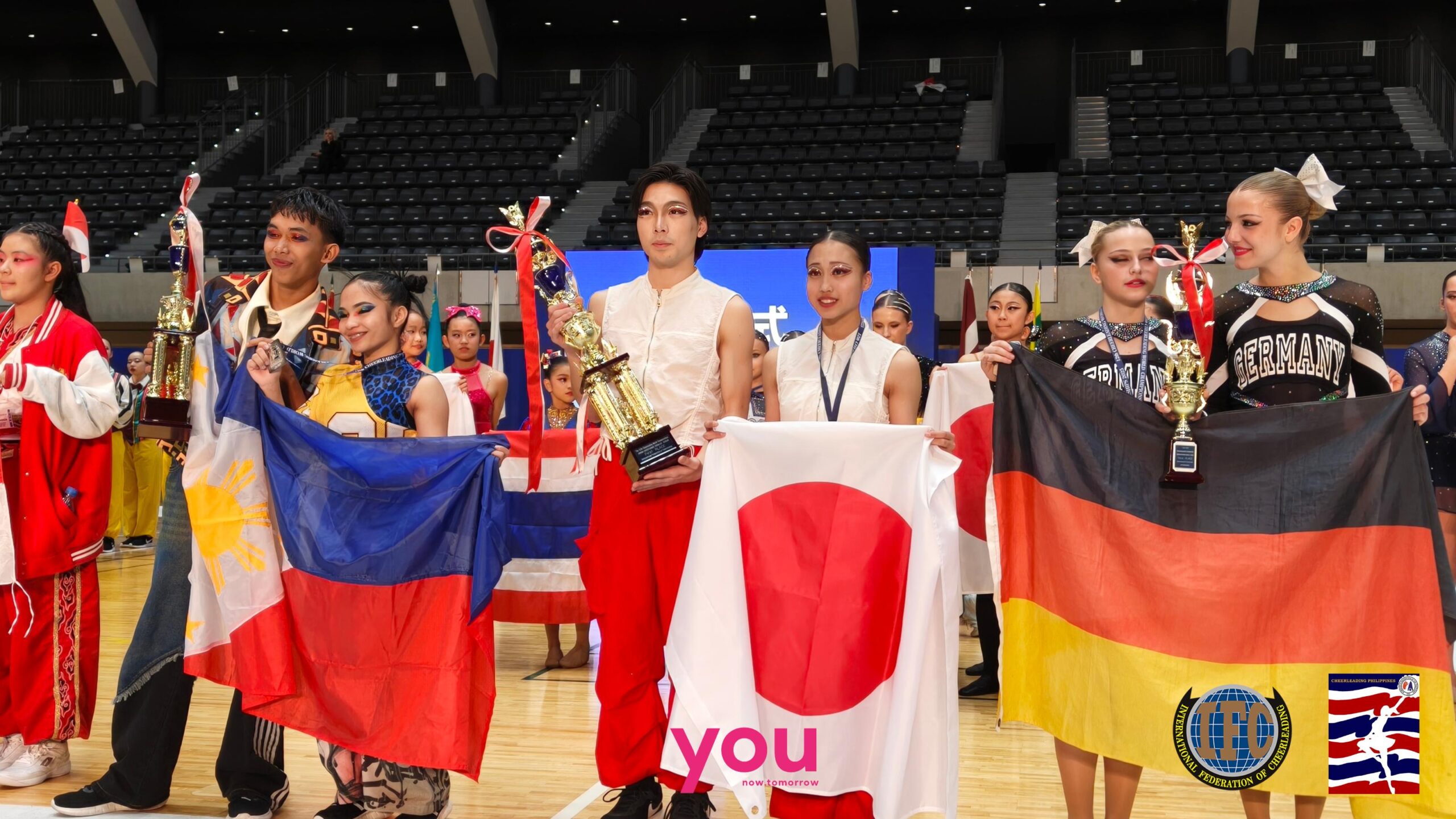
The duo landed second place, after Team Japan on the first place, and ahead of Team Germany (third place).
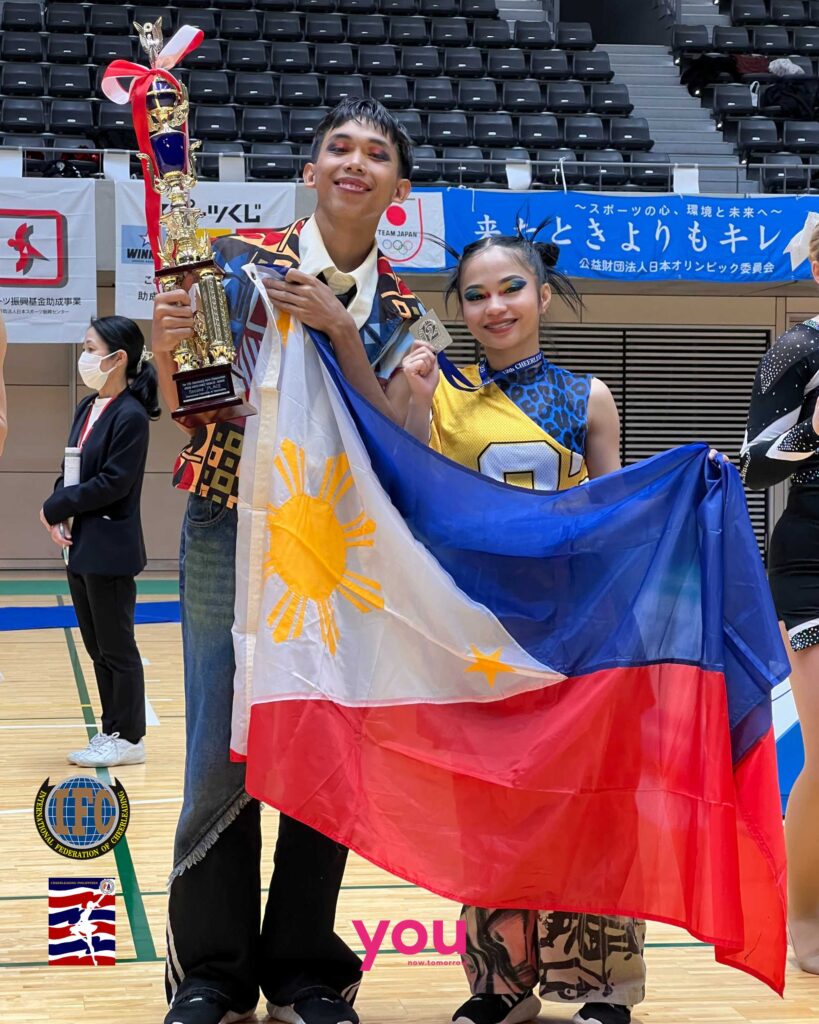
(Photo by Luis Carlo San Juan)
Proudly waving the Philippine flag, the duo accepted their 2nd place trophy and medals in a vibrant Takasaki Arena, “We were so shocked because we didn’t think we would even make it to the Top 2 because our opponents were so strong,” Aguirre said.
Andoy, who couldn’t hold back his emotions, said that they would have shouted that moment if they had the chance—“This was my first competition, and winning second place meant so much to me. I am forever grateful to God and to everyone who was involved in making this opportunity possible.
More memorable highlights from the 12th IFC Cheerleading World Championships